
Robotic Welding Cells
Cell layouts focused on a defined part family. Fixtures, positioners, sensing, and safety are designed as one package. View product →
In building steel and structural steel fabrication, high-mix and one-off production of beams, columns, stiffeners, and connection members sits at the center of welding-automation difficulty. This page outlines typical challenges and AGR products that may be assessed—High-Mix Robotic Welding Automation, Robotic Welding Cells, and Weld Preparation Automation. H-beam welding is a featured application in structural steel.

Structural steel fabrication handles beams, columns, ribs, stiffeners, and connection members that look similar but change in dimensions and joints. Repeating fixed programs alone often lets teaching time squeeze production capacity.
Structural steel workpieces commonly differ in assembly accuracy and groove condition member by member. For robotic welding, sensing methods for the weld seam and methods for generating robot motion must be designed assuming that variation. Without a design that tolerates variation, quality and productivity will not stabilize after robotization.
Structural steel fabrication often depends on skilled welder experience. As skill becomes person-dependent and talent is harder to secure, methods to stabilize weld quality and production are under review. Reasons to assess automation differ by project:
Whatever the primary reason, assessment starts by organizing target workpiece conditions and where the current issues sit.
Cell layouts focused on a defined part family. Fixtures, positioners, sensing, and safety are designed as one package. View product →
Welds through recognition and path generation when workpieces change. H-beam welding is a featured application in structural steel. View product →
As an upstream step in structural steel fabrication, groove preparation and chamfering automation can be assessed. View product →
Before automating structural steel welding, we confirm the following conditions. They become the starting point for fit and product selection.
Target members, joint types, thickness, and groove conditions.
One-off, high-mix low-volume, or higher-volume production.
Teaching and programming labor each time the workpiece changes.
Appearance and inspection requirements such as UT/RT.
Related technology: 3D recognition & automated programming (path generation) · Touch sensing & arc sensing · Trials & weld validation
Related reading: How we approach automated programming (offline teaching) · How we approach thick-plate robotic welding · FAQ
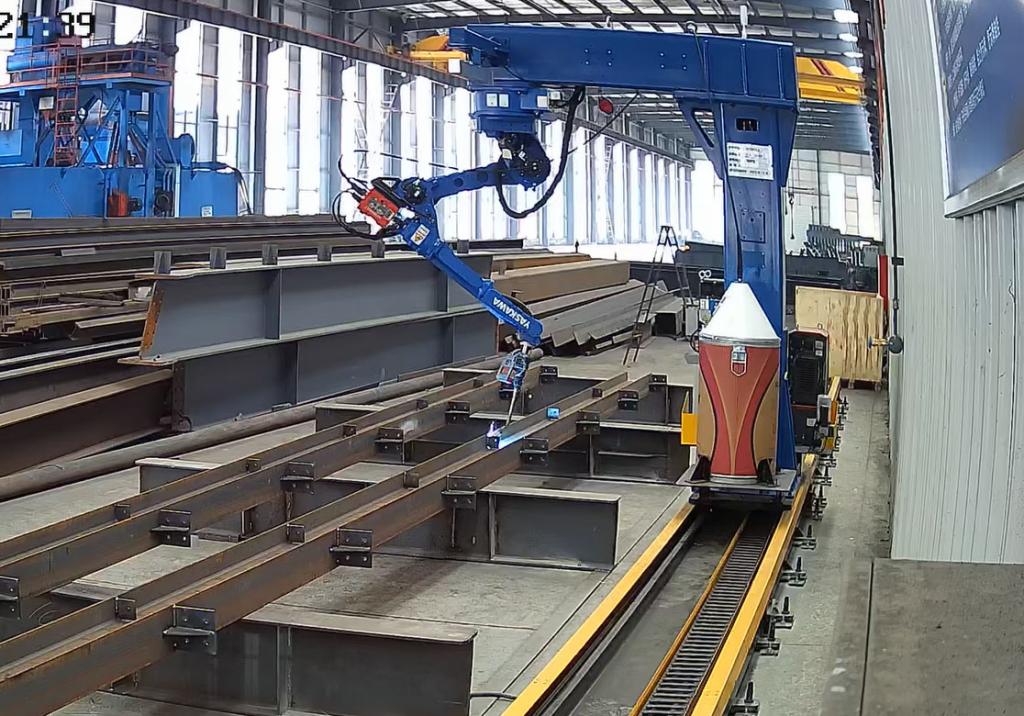
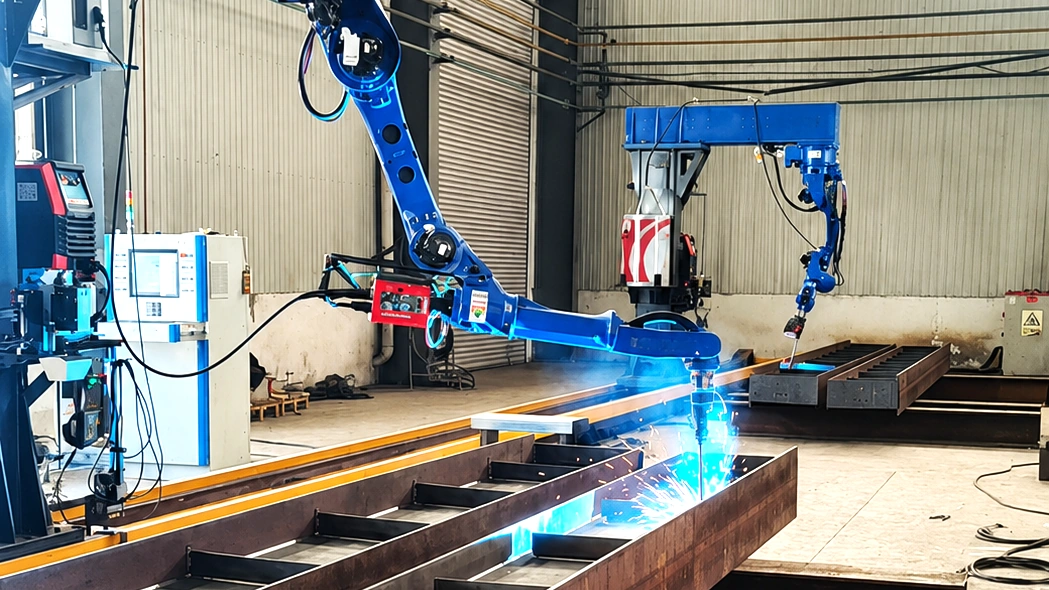
Customer-facing application of high-mix robotic welding automation for H-beam fabrication.
AGR Group factory production line for construction-machinery boom and arm welding.
When beams, columns, stiffeners, and connection members are one-offs or high-mix, teaching burden grows each time the workpiece changes and robot paths must be re-taught point by point. Groove variation, assembly accuracy, distortion, and inspection standards also differ by project. AGR organizes assessment targets—High-Mix Robotic Welding Automation (H-beam welding is a featured application), Robotic Welding Cells, and Weld Preparation Automation—from workpiece conditions, joints, and volume.
Welding of beams, columns, ribs, stiffeners, and connection members can be assessed where joint geometry, torch access, thickness, and inspection standards fit the conditions. It does not apply uniformly to every structural steel member. Fit is confirmed case by case.
High-Mix Robotic Welding Automation focuses on re-capturing weld targets through recognition and path generation when workpiece shape or mix changes. H-beam welding is a featured application of that approach. A Robotic Welding Cell is equipment built as a cell layout focused on a defined part family. Which path to choose depends on workpiece geometry, thickness, joints, and volume.
Drawings, photos, thickness, and joint data help the first assessment move faster.
Discuss H-beam & structural applications