
Automate high-mix frame welding in a robotic welding cell.
For vehicle frames, chassis-related structures, and similar agricultural-machinery parts produced in many variants. AGR evaluates changeover load and fixture design first, then proposes a cell layout that fits the actual production plan.

High-mix, low-volume production where changeover becomes the burden.
Agricultural machinery production often welds vehicle frames, chassis members, brackets, and related parts whose geometry changes by model and option—typically in high mix and small lots. Part mix and volume differ across tractors, combines, rice transplanters, and similar machine types.
- Thick-plate structural parts such as frames, chassis members, and brackets
- Dimensions and joints that change by model and option
- High-mix, low-volume production with seasonal demand
- Changeover frequency and the load of teaching and fixtures
Where demand is seasonal, volume can swing sharply between peak and normal periods. The point is to size the system to the real production pattern—not to overbuild capacity.

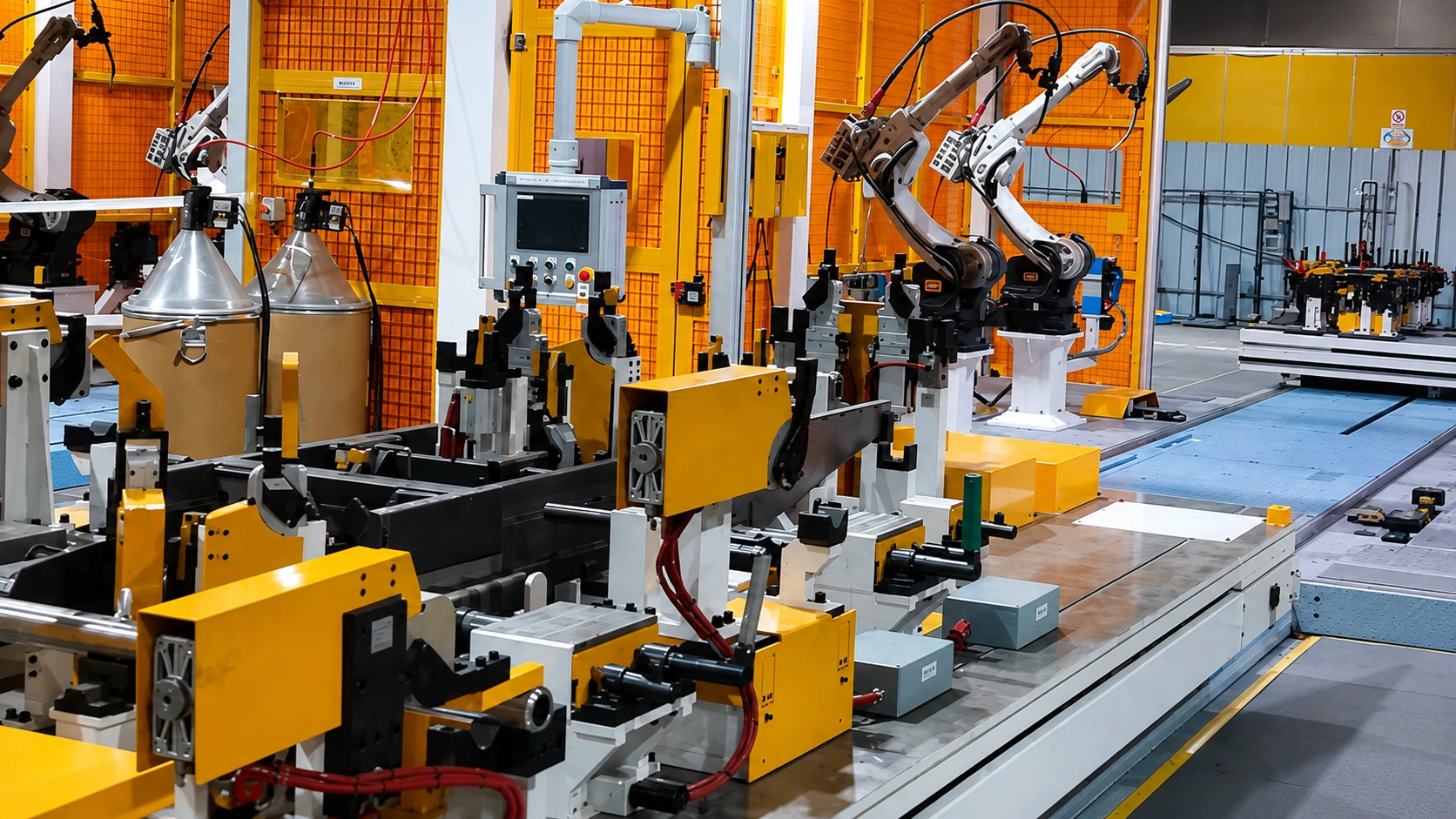
Changeover and teaching load need to be organized first.
- Teaching and program edits for each variant
- Fixture design, changeover time, and post-changeover repeatability
- Operator-dependent weld quality and rework
- Mixed production of parts with different plate thicknesses
In high-mix production, stabilizing a representative part family is usually more realistic than welding every variant on the same equipment. Defining that part family is the first assessment step.
Start with a cell, then combine products from workpiece conditions.
We typically center on Robotic Welding Cells. Depending on workpiece conditions, we may also reference High-Mix Robotic Welding Automation or Weld Preparation Automation. When bevel preparation sits upstream of frame welding, the process can be assessed as a whole.
- Cell proposals focused on a representative part family
- Fixtures and positioners designed as one system, with changeover time managed
- Touch sensing and arc sensing to handle joint variation
- Trial welding and process validation on real workpieces for quality and productivity
Related technology: Touch sensing & arc sensing · Trials & weld validation
Related reading: How we approach thick-plate robotic welding · Knowledge columns
Discuss agricultural structures
Part scope, mix count, volume, and seasonal variation help the first assessment move faster.
Request a Technical Assessment