
Robotic welding for construction-equipment structural parts.
For welding processes on thick-plate structural parts such as booms, arms, frames, and brackets. AGR assesses whether a robotic welding cell or an integrated line better fits the part family, production mix, and volume for each machine type.

Part families that change by machine type—often on the same production system.
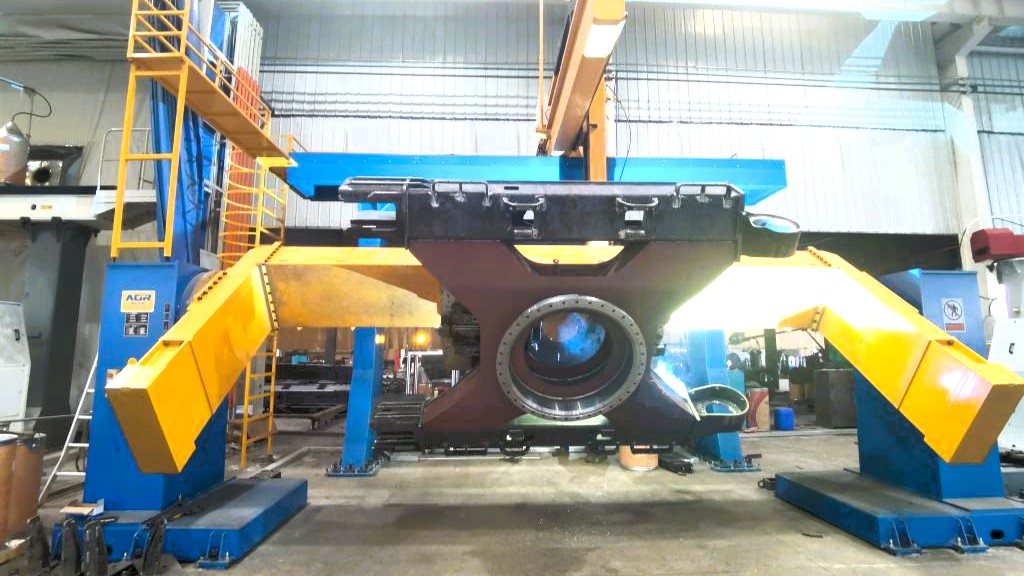
Construction-equipment production commonly processes part families that differ by model and specification—booms, arms, frames, swing frames, brackets, and related structures—on the same production system. Thick-plate welding is central, including groove welding, multi-layer multi-pass welding, and zones that need partial flipping or attitude control.
- Welding of large structural parts such as booms and arms
- Part families including frames, chassis members, and brackets
- Dimensions and joints that change by machine type and specification
- Thick-plate groove welding and multi-layer multi-pass welding
- Large workpieces that need flipping and positioning
Part dimensions carry machining and assembly variation. Fixed programs turn joint-location offset and root-gap differences into quality scatter. In high-mix production, confirming the weld seam with sensing and then deciding robot motion is an effective approach.
Where high-mix thick-plate welding tends to concentrate issues.
- Teaching and program-edit labor each time the mix changes
- Changing weld attitudes and quality that becomes operator-dependent
- Thick-plate distortion and the difficulty of restraint and fixture design
- Effort and safety around flipping and locating large workpieces
- Appearance and dimensional inspection requirements, plus rework
Some of these issues can be addressed in the welding process alone; others need process-wide design. The first step is to locate where the problem actually sits.
Separate cell vs. line by part family and volume.
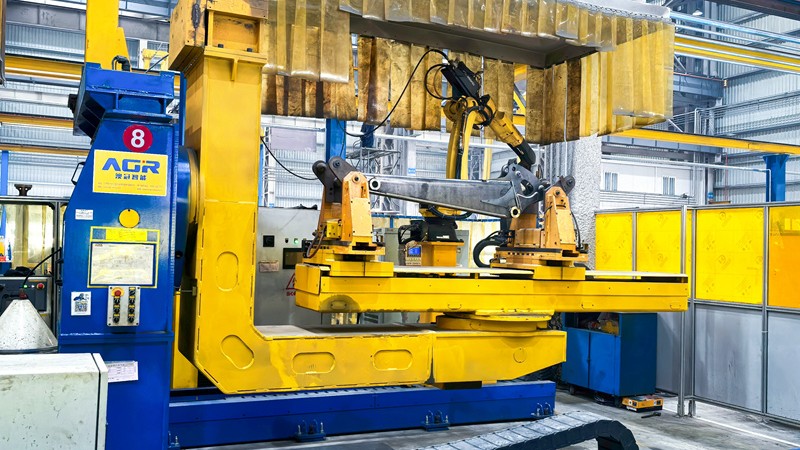
For structural welding automation on construction equipment, we start from Robotic Welding Cells. Where volume is higher and multiple process steps must be connected, we assess Robotic Welding Lines.
- Stabilize quality and productivity on a fixed part family → cell layout
- Integrate transfer, multiple stations, and upstream/downstream steps → line layout
- Touch sensing and arc sensing to handle joint-location variation
- Positioners and fixture design to manage weld attitude and distortion
Related technology: Touch sensing & arc sensing · Trials & weld validation
Related reading: How we approach thick-plate robotic welding · Positioner and fixture basics
Discuss construction-equipment structures
Part family, thickness, mix count, and volume help the first assessment move faster.
Request a Technical Assessment